Every few months there’s a new platform someone says you absolutely must be on. First it was Clubhouse. Then BeReal. Then everyone had a hot take about Threads.
Meanwhile, the businesses actually growing through social media are mostly still on Facebook, Instagram, and LinkedIn — doing the basics well, consistently, with a clear purpose for each platform.
Choosing the Best Social Media Platforms for Business isn’t complicated, but it does require honesty about your audience, your capacity, and what you’re actually trying to achieve. This guide cuts through the noise and tells you where to focus in 2026.
Why Best Social Media Platforms for Business Choice Matters More Than Content Volume
A common mistake is treating social media like a broadcasting network — the more places you post, the more people you reach. In theory, yes. In practice, spreading thin across six platforms usually means doing none of them well.
Each platform has its own content format, audience expectations, and algorithm behaviour. What works on Instagram Reels does not translate to LinkedIn. A Facebook ad campaign built for lead generation looks nothing like a YouTube pre-roll. Trying to repurpose the same content everywhere is a fast way to get average results everywhere.
Pick two, maybe three platforms based on where your customers actually spend time — then build a real presence there before expanding. That’s the approach that works.
The broader thinking behind this is covered in the Complete Guide to Social Media Marketing for Business Growth — worth reading if you’re building a strategy from scratch.
Facebook: Still the Most Versatile Business Platform
People write Facebook off constantly. It’s “old,” the organic reach is “dead,” younger audiences aren’t there. Some of that is true. None of it changes the fact that Facebook’s advertising infrastructure is the most powerful lead generation tool available to small and mid-size businesses in India today.
Over 350 million Indians are on Facebook. A significant chunk of them are homeowners, parents making household decisions, business owners, and working professionals. The idea that Facebook is irrelevant to Indian business marketing is simply not supported by what actually happens when you run campaigns there.
Facebook marketing for business works best in a few specific ways:
Lead Ads are the most underused format. The user never leaves the app — they see the ad, tap, and a form pre-fills with their details. On mobile, this reduces friction dramatically. For real estate, coaching institutes, clinics, and local service businesses, this format consistently delivers the lowest cost per lead of any channel.
Retargeting is where Facebook genuinely earns its budget. Website visitors, video viewers, people who engaged with your page — you can serve them specific ads based on exactly where they are in the buying process. A person who visited your pricing page three days ago should not be seeing the same awareness ad as someone who’s never heard of you.
WhatsApp integration has changed the lead flow for Indian businesses significantly. A Facebook ad that opens a WhatsApp chat skips the form entirely. For businesses where the conversation IS the sales process — interior designers, financial advisors, education counsellors — this works remarkably well.
Where Facebook struggles is organic reach. If you’re relying on posts to a business page to grow your audience without any paid support, results will be slow. Use Facebook primarily as a paid channel and treat organic posts as supporting material, not the main strategy.
Instagram: Where Trust Gets Built Visually
Instagram’s role in business marketing has shifted. Three years ago, a brand with a well-curated grid and consistent posting could grow an audience organically without much effort. The algorithm has changed. Organic growth is harder. But Instagram’s value for business is not gone — it’s just different now.
What Instagram does well in 2026 is trust-building. Someone who follows your account, watches your Reels regularly, and sees your client results and behind-the-scenes content develops a familiarity with your brand that no other format replicates as efficiently. By the time they contact you, they’re warm. They’ve already decided they like you. The sales conversation is shorter.
An Instagram marketing strategy for business in India should have a few non-negotiables:
Reels are still the primary reach driver. Short videos that teach something, show a result, or answer a common question in your niche get seen by people who don’t follow you yet. They’re the top-of-funnel engine.
Stories are for your existing audience — offers, polls, behind-the-scenes, quick updates. They keep your brand in front of people who already follow you.
DMs are an underrated lead channel. A call to action that says “DM us the word AUDIT and we’ll send you a free review” is simple, low-friction, and generates conversations with genuinely interested people.
Instagram works best for businesses with a visual dimension — food, fashion, interiors, fitness, travel, education, personal branding. B2B companies can make it work but need to invest more in content quality to see results.
LinkedIn: The Only Platform Built for B2B Lead Generation
If you’re selling to businesses — to founders, managers, department heads, procurement teams — LinkedIn is not optional. It’s where that audience spends professional attention online, and it’s the only platform that lets you target by job title, seniority, company size, and industry simultaneously.
The platform has matured a lot in the last few years. LinkedIn in 2026 is genuinely active — not just a digital resume site. Decision-makers are reading content, engaging with opinions, and following brands and individuals they find credible.
For Indian B2B companies in sectors like IT services, SaaS, HR tech, staffing, consulting, and manufacturing, LinkedIn lead generation delivers something other platforms can’t: leads who are already pre-qualified by their job role. If someone at a 200-person company with the title “Head of Operations” downloads your logistics audit guide, you know exactly who you’re calling.
The combination that works: publish genuinely useful content consistently — opinions, frameworks, client results, industry observations. Then run LinkedIn Lead Gen Forms to warm audiences. The content builds the relationship; the paid campaign captures the lead.
One honest caveat: LinkedIn is expensive. CPL runs significantly higher than Facebook or Instagram. But in B2B, one closed deal from a LinkedIn lead can justify months of campaign spend. Evaluate it on cost per acquisition, not cost per lead.
YouTube: Underused, High Intent, Long-Term Asset
Most Indian businesses either ignore YouTube or dabble in it without commitment. That’s actually an opportunity.
YouTube is the second-largest search engine in the world. People come to it looking for answers, comparisons, tutorials, and reviews — high-intent behaviour that’s very different from passive social scrolling. A video ranking for “best accounting software for small business India” in 2026 can generate leads for years without additional spend.
The barrier to entry is production effort, which is why many businesses avoid it. But the bar for quality in most B2B and service categories is still surprisingly low. A well-structured, clearly explained video with decent audio will outperform most competitors in niche business topics.
YouTube also integrates with Google Ads, which means you can run pre-roll ads targeted to people searching for specific keywords. For high-consideration purchases — ERP software, legal services, medical devices, investment products — this format reaches people at exactly the right moment.
If you have the capacity for video, YouTube deserves a proper strategy, not just a dumping ground for repurposed Instagram content.
Platform Comparison for Indian Businesses in 2026
| Platform | Best Suited For | Typical CPL India | Content Effort | Organic Reach |
| B2C, Local Services, Real Estate | ₹80–₹350 | Medium | Low | |
| Visual Brands, D2C, Personal Brands | ₹100–₹450 | High | Medium | |
| B2B, Professional Services, SaaS | ₹600–₹2,500 | Medium | Medium | |
| YouTube | High-consideration, Search-intent | ₹150–₹600 | Very High | High (long-term) |
| Twitter/X | Tech, Media, Niche commentary | ₹200–₹900 | Low | Low |
What Most Businesses Get Wrong About Platform Selection
They choose based on where they personally spend time, not where their customers are. A founder who’s active on Twitter assumes their B2B audience is there too. Sometimes that’s true. Usually it isn’t.
They try to maintain too many platforms. Managing Facebook, Instagram, LinkedIn, YouTube, and Twitter simultaneously with a small team means five mediocre presences instead of two strong ones. Consolidate first, expand later.
They measure the wrong things. Follower count and post reach feel good but don’t pay salaries. The metric that matters is leads generated — and ideally, leads that convert to customers. Everything else is context. If you’re not measuring this, you don’t actually know which platforms are working.
If social media lead generation is the goal — which it should be for most businesses — the supporting breakdown of how Social media lead generation works across platforms walks through the tactical side in more detail.
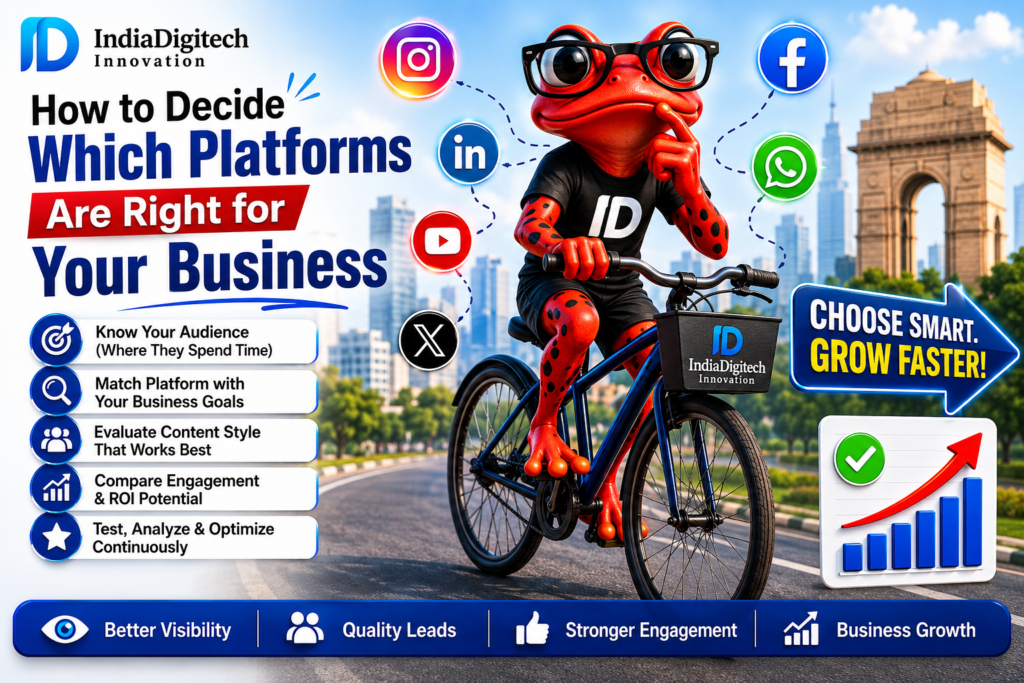
How to Decide Which Platforms Are Right for Your Business
Three questions are usually enough:
Who is your customer, and where do they spend time online? If you’re selling HR software to mid-size companies, LinkedIn is obvious. If you’re running a bakery in South Delhi, Instagram and Facebook make more sense. Don’t overthink it.
What type of content can you create consistently? If nobody on your team is comfortable on camera, YouTube is the wrong starting point. If you have strong writers, LinkedIn and Facebook work well. Align platform choice with your actual capabilities.
What’s your sales cycle? Short sales cycles — someone sees an ad and buys or enquires within days — suit Facebook and Instagram. Long sales cycles with multiple decision-makers suit LinkedIn and YouTube, where you can build familiarity and credibility over time before asking for anything.
Working With a Social Media Marketing Agency in Delhi
Knowing which platforms to use is one thing. Building campaigns that actually generate results on those platforms is another.
The Delhi-NCR market has its own competitive realities. CPLs are higher than most Indian cities in several categories. Audiences are more ad-savvy. Seasonal demand patterns — Diwali, financial year-end, academic admission cycles — significantly affect when budget should be pushed harder.
A social media marketing agency in Delhi that understands these patterns brings practical value beyond just “managing your accounts.” Platform selection, audience targeting, creative testing, lead management — these are the levers that determine whether a campaign generates 20 leads a month or 200.
India Digitech Innovation works with Delhi-NCR businesses on this end-to-end — not just which platforms to be on, but how to build a system on those platforms that generates consistent, qualified pipeline. If that’s a conversation worth having for your business, start here.
Frequently Asked Questions
Which is the best social media platform for business in India in 2026?
There’s no single answer. Facebook and Instagram cover most B2C and local service businesses well. LinkedIn is the right choice for B2B. YouTube is worth the investment for businesses where education drives the purchase decision. The best platform is the one where your specific customers spend time.
Is Facebook still relevant for business marketing in 2026?
Yes, especially for paid campaigns. Facebook’s ad targeting and lead generation formats are still among the most effective available to Indian businesses, particularly for local services, real estate, and education.
How many social media platforms should a small business use?
Start with two. Do them well before adding more. Most small businesses spread too thin too early and end up with weak presence everywhere rather than a strong presence somewhere.
What is the cost of social media marketing for business in India?
It varies widely. Organic social costs time, not money. Paid campaigns on Facebook and Instagram can start at ₹5,000–₹10,000 per month for small businesses. Professional agency management with paid ad budget typically starts at ₹20,000–₹50,000 per month for meaningful results.
Can a social media marketing company in Delhi help with platform selection?
Yes — and platform selection is one of the first things a good agency should address before touching any creative or ad spend. The wrong platform choice wastes budget regardless of how good the campaigns are.
India Digitech Innovation is a social media marketing company in Delhi helping Indian businesses build real pipeline through platform-specific strategy and performance-focused campaigns.
Pingback: Social Media Marketing vs Paid Ads What Works Better 2026