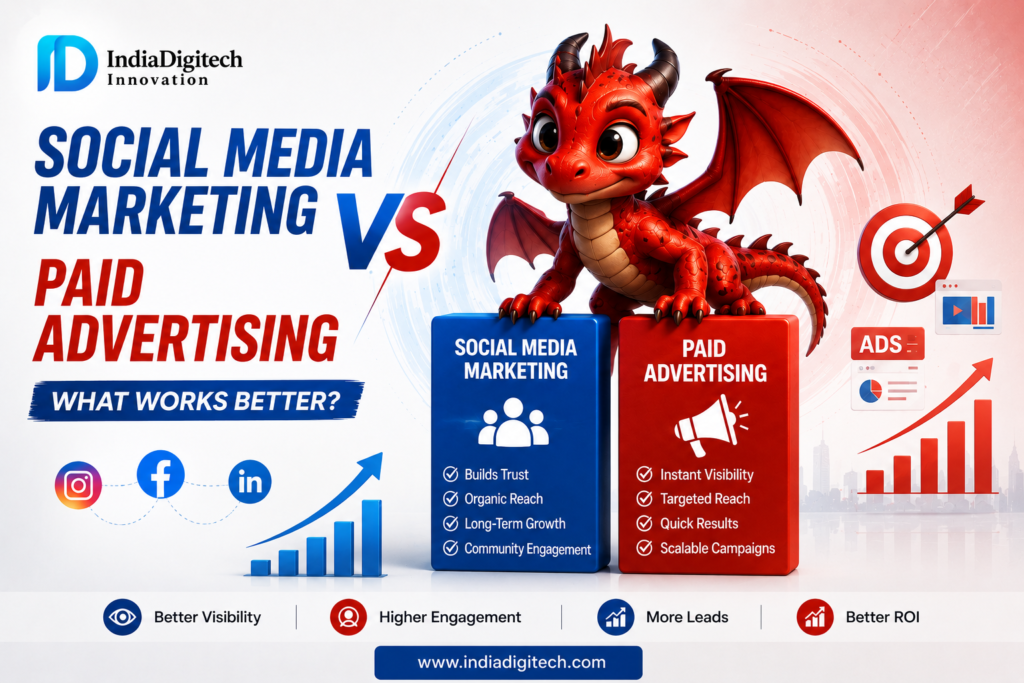
This question comes up in almost every first conversation with a new client. And the honest answer — which most agencies avoid giving because it’s not a clean sell — is that it depends on what problem you’re actually trying to solve.
Businesses chasing quick leads have different needs than brands building long-term authority. A bootstrapped founder with more time than money is in a different situation than a funded startup trying to scale fast. There’s no universal winner here.
That’s why the social media marketing vs paid ads discussion often creates confusion for business owners.
What I can tell you is what each approach actually does, where each one breaks down, and how businesses in Delhi and across India are combining the two to get results without wasting budget on the wrong channel at the wrong time.
What We’re Actually Comparing
Before anything else, let’s be clear on what these two things are — because the terms get mixed up constantly.
Organic social media marketing means everything you do on social platforms without paying to distribute it. Posts, Reels, carousels, LinkedIn articles, comments, community engagement. Your content reaches people who already follow you, and occasionally beyond that through shares or algorithmic distribution. It costs time, not money — though that’s not the same as free.
Paid social advertising means you’re paying a platform — Facebook, Instagram, LinkedIn, YouTube — to show your content to a defined audience, whether they follow you or not. You control who sees it, when, and how often. You stop paying, it stops showing.
Both fall under the broader umbrella of social media marketing for business. But they serve different purposes, work on different timelines, and require different skills to execute well.
The Case for Organic Social Media
Organic content builds something that paid ads simply cannot: genuine credibility over time.
When someone follows your brand for three months, reads your posts, watches your videos, and sees you consistently showing up with useful content — they develop trust before any sales conversation happens. That trust changes how they engage when you eventually ask for something. Conversion is easier. Objections are fewer. The relationship already exists.
For Indian businesses specifically, this matters more than people realise. Indian consumers — and B2B buyers — tend to research thoroughly before making decisions. They check Instagram profiles, look at the quality of LinkedIn posts, scroll through Facebook pages. If your organic presence looks abandoned or generic, it damages credibility even if your paid ads are excellent.
Organic social also has compounding value. A well-crafted post, a useful Reel, a detailed LinkedIn article — these continue generating reach and engagement weeks or months after publishing. Paid ads stop the moment the budget runs out. The return on organic effort accumulates.
Where organic struggles is speed and control. You can’t dictate who sees your content. Reach on most platforms without paid support has dropped significantly over the last few years — Facebook business page posts organically reach 2-5% of followers on a good day. If you need leads next month, organic alone will not get you there.
The Case for Paid Advertising
Paid social advertising solves the one problem organic can’t: reaching the right people immediately, at scale, whether they know you exist or not.
This is genuinely powerful. Facebook and Instagram let you target by location, age, income, interest, and behaviour. LinkedIn lets you target by job title, industry, company size, and seniority. You can put your message in front of exactly the profile of person you want to reach — tomorrow morning if needed.
For lead generation specifically, paid social advertising has a measurability that organic doesn’t. You know your cost per click, cost per lead, and eventually cost per customer. You can test two different ad creatives, see which converts better in 48 hours, and double down on the winner. That feedback loop is hard to replicate with organic content.
The results we covered in the Best Social Media Platforms for Business guide show this clearly — Facebook lead ads delivering ₹80–₹350 CPL, LinkedIn pulling qualified B2B leads in the ₹600–₹2,500 range. Those numbers are achievable when targeting and creative are done right.
The limitation of paid is dependency. The moment you stop spending, the leads stop. There’s no asset being built in the background. And if campaigns aren’t set up carefully — wrong audience, weak offer, no retargeting structure — money disappears fast with nothing to show for it. Bad paid social is one of the most efficient ways to burn a marketing budget.
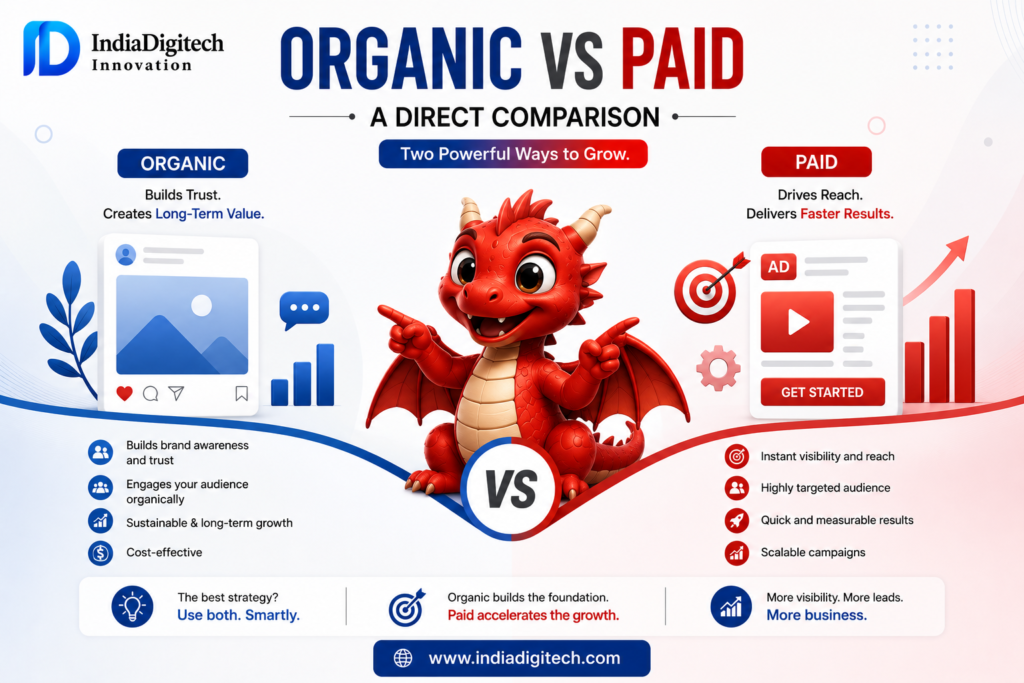
Organic Social media marketing vs Paid ads: A Direct Comparison
| Factor | Organic Social Media | Paid Social Advertising |
| Cost | Time and content creation | Ad budget + management |
| Speed to results | Slow (2–6 months) | Fast (days to weeks) |
| Reach control | Algorithm-dependent | Fully controllable |
| Lead generation | Indirect, long-term | Direct, immediate |
| Audience building | Strong | Weak (stops with spend) |
| Trust building | Strong | Moderate |
| Measurability | Moderate | High |
| Long-term ROI | Compounds over time | Stops when budget stops |
Neither row wins across the board. That’s the point.
Social Media ROI: How Each One Pays Off
ROI from organic social is real but slow and harder to attribute. A client who found you through a LinkedIn post six months ago, followed you, watched your content, and finally reached out — that’s organic ROI. Most businesses undercredit it because the attribution isn’t clean.
Paid social ROI is faster and more traceable. You can see exactly how many leads came from a campaign, at what cost, and how many converted. For businesses that need to justify marketing spend to stakeholders, this clarity has real value.
The honest truth about social media Marketing agency in delhi ROI is that businesses chasing either one exclusively usually underperform. Organic without paid grows too slowly for most business timelines. Paid without organic sends people to a dead-looking profile, which kills trust and raises CPL because your audience hasn’t been warmed up.
The combination — organic content building trust and audience, paid campaigns converting that warm audience into leads — is where the real efficiency sits.
What a Social Media Advertising Strategy Actually Looks Like
A common mistake is treating paid social as a tap you turn on when you need leads. That’s not a strategy. That’s panic spending.
A proper social media advertising strategy has structure:
Awareness layer — content or ads reaching new audiences who don’t know you yet. Goal is relevance, not conversion.
Consideration layer — retargeting people who engaged with awareness content or visited your website. Now you give them something worth acting on — a free resource, a case study, a webinar.
Conversion layer — lead form ads, click-to-WhatsApp campaigns, direct offers. Audience is warm. Ask is clear. This is where leads get generated.
Running only the conversion layer — which is what most businesses do — is like proposing marriage on a first date. The ask is too big for where the relationship is. Build the sequence first.
Which One Should You Choose Social media Marketing vs paid ads?
Here’s a practical way to think about it based on where your business actually is.
Choose paid social first if:
- You need leads within 30–60 days
- You have a defined budget and can commit to consistent spend
- Your product or service has a clear, specific audience you can target
- You’re launching something new and need immediate market feedback
Focus on organic first if:
- Budget is tight and you have more time than money
- You’re building a personal brand or thought leadership position
- Your sales cycle is long and trust is a significant buying factor
- You’re in a niche where community and credibility matter more than volume
Run both if:
- You’ve been running paid and CPL has plateaued — organic content warms the audience and brings CPL down
- You’ve been doing organic for 6+ months and growth has stalled — paid amplifies what’s already working
- You’re in a competitive market like Delhi where being visible across paid and organic both matters
Most businesses at growth stage — generating revenue, trying to scale — should be doing both. The question is ratio, not either-or. Start wherever you are and add the other layer as capacity allows.
What This Looks Like for Delhi Businesses
The Delhi-NCR market has specific dynamics worth naming. Competition is high, CPLs are above national averages in most categories, and audiences here are more ad-literate than smaller cities — they scroll past generic creative faster.
That means organic content quality matters more in Delhi, not less. A poorly shot Reel or a generic LinkedIn post doesn’t just underperform — it actively damages perception in a market where competitors are investing in quality.
It also means paid campaigns need tighter targeting and better creative to justify the spend. A broad audience campaign that might work in a Tier 2 city will bleed budget in Delhi without strong segmentation.
Working with a social media marketing company in Delhi that understands this market specifically — the competitive landscape, seasonal demand patterns, platform behaviour of Delhi audiences — makes a measurable difference to campaign efficiency.
India Digitech Innovation handles both sides: organic content strategy and paid campaign management, built as a system rather than two separate things running in parallel. If you’re trying to figure out the right mix for your business specifically, that’s the conversation to have with us.
Frequently Asked Questions
Is organic social media marketing still worth it in 2026?
Yes — but the expectation needs to be realistic. Organic reach on most platforms has declined, but the trust and credibility built through consistent content still directly influences buying decisions. It’s a long game, not a quick-win channel.
Which delivers better ROI — organic or paid social?
Paid social delivers faster, more measurable ROI. Organic delivers better long-term ROI because it builds compounding value over time. Most businesses get the best return combining both rather than committing entirely to one.
How much should I spend on paid social media advertising?
There’s no fixed answer, but for Delhi businesses, meaningful results on Facebook or Instagram typically require ₹15,000–₹30,000 per month in ad spend at minimum, plus management. LinkedIn requires higher budget due to higher CPL, usually ₹30,000+ per month to generate consistent B2B leads.
Can paid ads work without organic content?
They can, but performance is usually lower. When someone clicks an ad and visits an empty or low-quality profile, trust drops and conversion rate suffers. Organic content acts as social proof that makes paid campaigns more effective.
What is a good social media advertising strategy for a small business?
Start with one platform, one audience segment, one clear offer. Run a small paid campaign to test what resonates. Use whatever performs well as the basis for your organic content. Expand from there rather than trying to build everything at once.
How do I know if my social media marketing services in Delhi are delivering ROI?
Track cost per lead, lead-to-customer conversion rate, and revenue attributed to social. Vanity metrics — likes, reach, follower growth — don’t pay bills. If your agency isn’t reporting on leads and pipeline, that’s worth addressing.
India Digitech Innovation provides social media marketing services in Delhi for businesses that want measurable pipeline, not just managed accounts. Talk to our team about what the right organic-paid mix looks like for your business. Learn for more Details follow our Instagram Handle India Digitech Innovation
Related Article – Complete Guide to Social Media Marketing
Pingback: How to Create Powerful Social Media Marketing Strategy 2026