
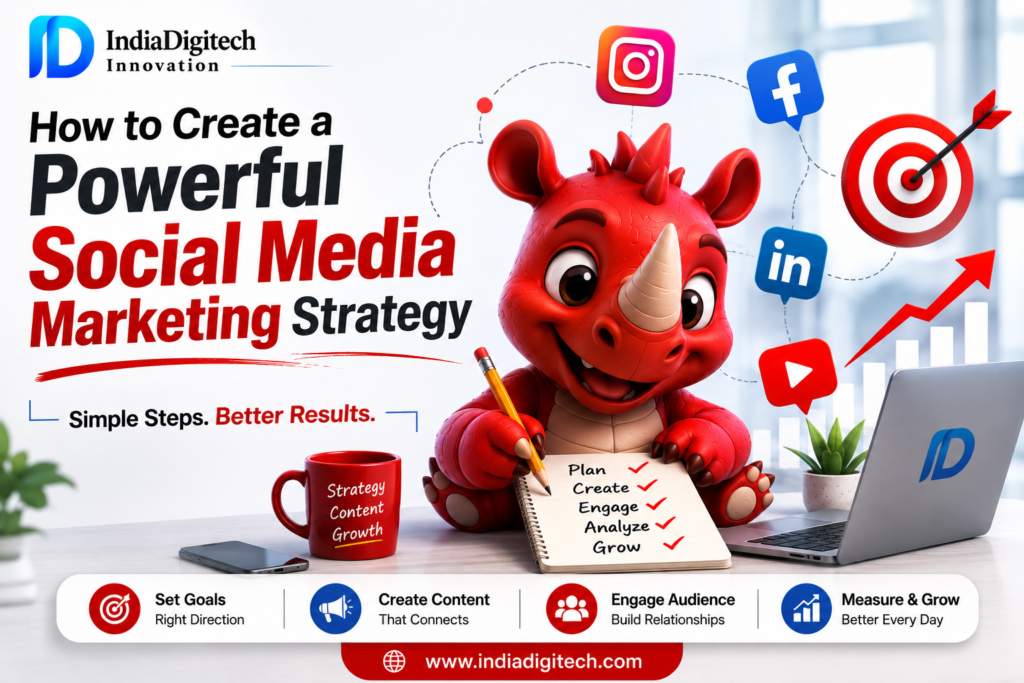
Almost every business I’ve worked with already has a social media marketing strategy of some kind — they just don’t realise it’s a bad one. “Post three times a week and see what happens” is a strategy. It’s just not one that generates leads, builds a brand, or justifies anyone’s time.
A strategy that actually works has a few non-negotiable parts: a clear goal, a defined audience, a content system, a distribution plan, and a way to measure whether any of it is working. Skip even one of these and the rest tends to fall apart eventually.
Many businesses investing in social media marketing services in Delhi struggle because they focus on posting content before building a proper strategy.
What a Social Media Marketing Strategy Actually Needs
A real social media marketing strategy is a documented plan that connects your business goals to specific platform activity — what you post, where, how often, for whom, and why. Without that connective tissue, you’re just producing content and hoping something sticks.
Most businesses get this backwards. They start with content ideas — “let’s do a reel,” “let’s run a giveaway” — instead of starting with the goal that content is supposed to serve. The order matters. Goal first, audience second, content third, distribution fourth, measurement last.
This is the same foundational thinking covered in the Complete Guide to Social Media Marketing for Business Growth — if you haven’t read that yet, it’s a useful starting point before getting tactical here.
Step 1: Define a Goal That Isn’t “More Engagement”
“We want more engagement” is not a goal. It’s a vague feeling dressed up as one. Engagement is a means, not an end — nobody pays salaries with likes.
Pick a goal that connects to revenue or business outcome. A few examples that actually work:
- Generate a specific number of qualified leads per month
- Build enough audience trust to shorten the average sales cycle
- Drive direct traffic and conversions on a product page
- Establish founder or brand authority in a niche where credibility drives referrals
Each of these points to different tactics. A lead-generation goal needs paid campaigns and clear offers. An authority goal needs consistent, high-quality content over a longer time horizon. Decide which one you’re solving for before anything else gets planned.
Step 2: Know Exactly Who You’re Talking To
Vague audience definitions (“small business owners,” “young professionals”) produce vague content that resonates with nobody specifically.
Get specific. Job role, income bracket, city or region, the actual problem they’re dealing with that brings them to you. A coaching institute targeting “students” is too broad. “Class 12 students in Delhi preparing for competitive exams, whose parents are actively researching coaching options” gives you something to write content for.
This is one of the most common issues a social media marketing company in Delhi encounters when onboarding new clients.
Step 3: Build a Social Media Content Strategy Around Real Topics
A social media content strategy is the part most businesses spend the most time on and get the least value from, mainly because they’re creating content without a clear theme.
Pick three to five content pillars — recurring topics you can credibly speak on and that your audience actually cares about. A financial advisory firm might run pillars like: common investment mistakes, market explainers, client success stories, and regulatory updates. Everything you post maps back to one of these.
This does two things. It makes content planning faster because you’re not starting from zero every week. And it builds topical authority — both with your audience and with platform algorithms that reward consistency in a niche over random variety.
Within each pillar, mix formats. Educational posts that teach something. Social proof — testimonials, case studies, results. Behind-the-scenes content that humanises the brand. Direct offers, used sparingly. A content calendar that’s 80% value and 20% promotion tends to outperform one that’s constantly selling.
Step 4: Build a Social Media Engagement Strategy, Not Just a Posting Schedule
Posting content and engaging with an audience are two different activities, and most businesses only do the first one.
A real social media engagement strategy includes responding to comments within a reasonable window, not days later. Initiating conversations in your niche — commenting thoughtfully on relevant posts from prospects or industry peers, not just posting and disappearing. Using polls, questions, and interactive formats in Stories or LinkedIn posts to invite responses rather than passive scrolling. And monitoring DMs as a genuine channel, not an afterthought — a surprising number of leads start as a casual question in the inbox.
Engagement compounds. A brand that consistently responds and participates builds a different relationship with its audience than one that broadcasts and goes quiet. Algorithms on most platforms also reward accounts with genuine two-way interaction over those that just post and leave.
Step 5: Choose Platforms Based on the Plan, Not Habit
By this point, your goal and audience should make platform choice fairly obvious. A B2B service business with a long sales cycle probably needs LinkedIn as the primary channel. A visually-driven D2C brand probably needs Instagram. A local service business needs Facebook for paid lead generation.
Don’t spread across five platforms because competitors are everywhere. Two platforms done properly outperform five done half-heartedly almost every time. Build proof of concept on one or two channels before expanding.
Step 6: Decide How Much Is Organic and How Much Is Paid
This is where a lot of strategies stay incomplete — they plan content but never decide how it gets distributed.
Organic builds trust slowly. Paid generates reach and leads quickly but stops the moment spend stops. Most businesses need both, but the ratio depends on timeline and budget. A business that needs leads in the next 60 days should weight heavily toward paid. A business building a long-term brand with more time than urgency can lean organic, adding paid amplification once content proves what’s working.
This distinction — and how to decide your own mix — is covered in more depth in the Social Media Marketing vs Paid Ads comparison, worth reading before finalising your budget split.
Step 7: Set Up Measurement Before You Launch Anything
If you can’t measure it, you can’t improve it — and most businesses only start thinking about measurement after a few months of posting with nothing to show.
Set this up on day one. Track reach and engagement as leading indicators, but treat them as context, not success metrics. Track leads generated, cost per lead if running paid, and conversion rate from lead to customer as the actual measures of whether the strategy is working. Review monthly, not daily — social media results take time to stabilise, and overreacting to short-term fluctuations leads to strategy whiplash that never lets anything actually work.
The 7-Step Social Media Marketing Plan Framework
Here’s the sequence in order, as a quick reference:
- Define the goal — leads, authority, traffic, or sales. Pick one primary focus.
- Define the audience — specific enough to write content for one real person, not a vague segment.
- Build content pillars — 3 to 5 recurring themes that map to audience needs.
- Plan engagement activity — not just posting, but responding, initiating, and monitoring.
- Select platforms — based on where the audience actually is, not where you’re comfortable.
- Decide the organic-paid mix — based on timeline and budget realities.
- Set up measurement — leads and conversions as the real scoreboard, engagement as context.
A genuinely strong social media marketing strategy isn’t complicated once it’s broken down like this. The difficulty is usually discipline — sticking to the plan past the first slow month, not abandoning content pillars because one post underperformed, and resisting the urge to chase every new platform trend that shows up.
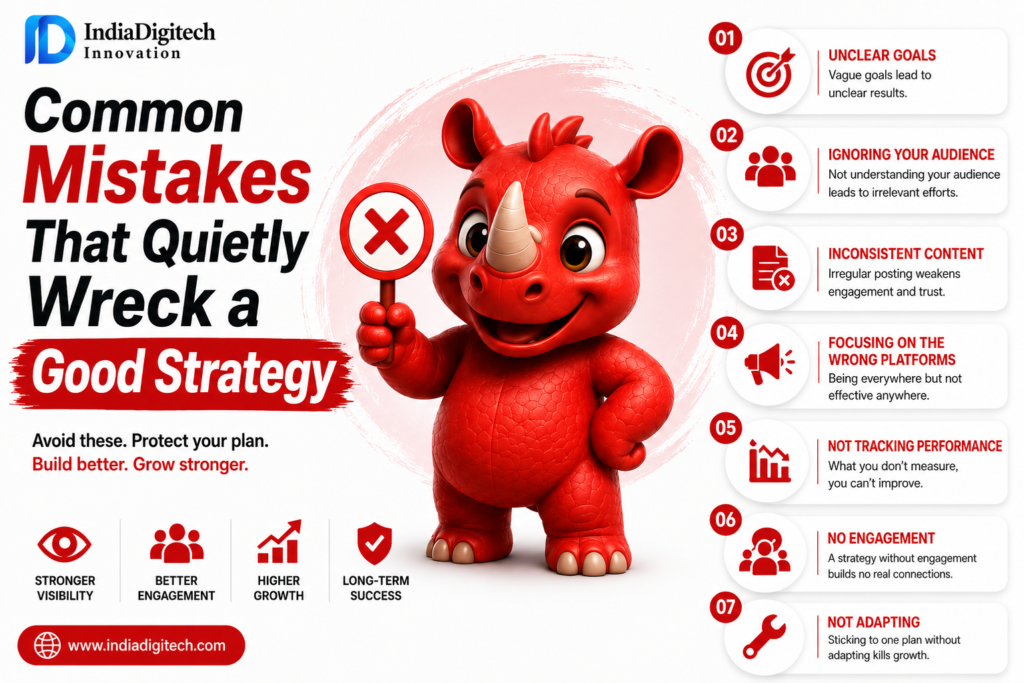
Common Mistakes That Quietly Wreck a Good Strategy
Changing direction too soon. Most strategies need 90 days minimum before there’s enough data to judge what’s working. Pulling the plug after three weeks because results feel slow is the single most common reason strategies fail before they had a real chance.
Copying competitor content without understanding why it worked for them. What works for one brand’s audience and positioning doesn’t automatically transfer.
No clear owner. Strategy documents that nobody is accountable for executing become shelf decoration. Someone — internal or agency — needs to own execution and report on it regularly.
Treating the plan as fixed. A strategy should adapt based on what the data shows after 60–90 days, not stay rigid because that’s what was originally written down.
When to Bring In Professional Support
Some businesses build and execute their own social media marketing plan well — particularly founders with strong content instincts and time to invest. Others find that the gap between knowing what should happen and actually executing it consistently, with proper paid campaign management and creative testing, is wide enough to justify outside help.
A social media marketing agency in Delhi that’s run this process repeatedly across different industries brings pattern recognition that’s hard to build internally — what content pillars tend to work for which audience types, what CPL benchmarks are realistic, how long a strategy genuinely needs before it’s fair to judge it.
India Digitech Innovation works as a social media marketing company in Delhi building exactly this kind of structured, accountable strategy for businesses — not generic content calendars, but plans tied to actual leads and revenue. If you’re trying to figure out whether to build this in-house or bring in support, that’s a conversation worth having before committing budget either way.
Frequently Asked Questions
What is a social media marketing strategy? It’s a documented plan connecting business goals to specific social media activity — what content gets created, for which audience, on which platforms, and how success gets measured. Without this structure, social media activity tends to be reactive rather than purposeful.
How long does it take to build an effective social media marketing plan? Building the plan itself takes a few days to a couple of weeks, depending on how much research goes into audience and competitor analysis. Seeing meaningful results from execution typically takes 60 to 90 days for organic strategies, faster for paid campaigns.
What’s the difference between a content strategy and a marketing strategy? A social media content strategy is one component of the broader marketing strategy — specifically, what you create and post. The full marketing strategy also includes goals, audience definition, platform selection, distribution (organic vs paid), and measurement.
How important is engagement strategy compared to content strategy? Both matter, but engagement is frequently neglected. A strong content calendar with no real interaction — slow comment responses, no DM monitoring, no community participation — underperforms a moderate content plan paired with active, consistent engagement.
Should small businesses hire a social media marketing agency in Delhi or do it themselves? Depends on internal capacity and how quickly results are needed. Businesses with strong content skills and time can manage organic well in-house. Once paid campaigns, multi-platform management, and consistent strategy execution are needed, professional support usually pays for itself through better targeting and faster results.
How often should a social media marketing strategy be reviewed? Monthly for performance check-ins, with a deeper strategic review every 90 days. Daily or weekly overreaction to fluctuating numbers tends to do more harm than good — most platforms need time to stabilise data before patterns become reliable.
India Digitech Innovation offers social media marketing services in Delhi, building strategies tied to real business outcomes rather than vanity metrics. Get in touch to talk through what a working strategy looks like for your business.
Get in touch on Our Instagram Handle India Digitech Innovation
Pingback: Why Businesses Should Hire Social Media Marketing Agency